


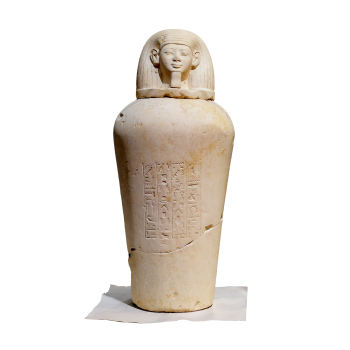
Jars from the 18th period of the ancient Egyptian dynasty
It is a cultural relic from the 18th period of the ancient Egyptian dynasty, approximately from 1400 BC to 1352 BC, during the reigns of Thutmose III to Amenhotep III. Discovered by Egyptologist Howard Carter and millionaire businessman Theodore M. Davis in King's Valley in 1902. Carter later discovered Tutankhamun's tomb, while Davis donated these artifacts to the Harvard University Museum of the Ancient Near East. Usually a set of four pieces is used to store the internal organs of mummified corpses. This exquisitely carved jar is one of three excavated jars in King's Valley.

Korean Dynasty blue and white porcelain "dragon blue and white porcelain jar"
This porcelain is a Korean artifact from the Joseon Dynasty (1392-1910). Its name is "dragon pattern blue and white porcelain jar". The decoration of this jar is very fine, including the underglaze blue dragon design. This jar was probably used as a vase in an official courtyard ceremony. It has an overall height of 39.5cm and a bottom diameter of 14.7cm. This jar was made in the 1700 s and is now in the collection of the Cleveland Museum of Art.

Popular Models


Honey Badger (3D animated model)
192 View

Guinea fowl (3D animated model)
163 View

Wild Goose (3D animated model)
185 View

Red Fox (3D animated model)
153 View
Random Model


Catholic Church of Auxerre, France
903 View


Metal paper clip OBJ model
734 View

Carrefour Cup replica 3D model
1575 View

Mount St. Helens
853 View

Adidas Yeezy 500 Dark sneaker
789 View


Vintage tin shell alarm clock
833 View